Knowledge & Assets
An AI model knows a great deal about the world and nothing at all about your business. This section is how you fix that: document stores give a flow something to answer from, and assets give it files to hand out.
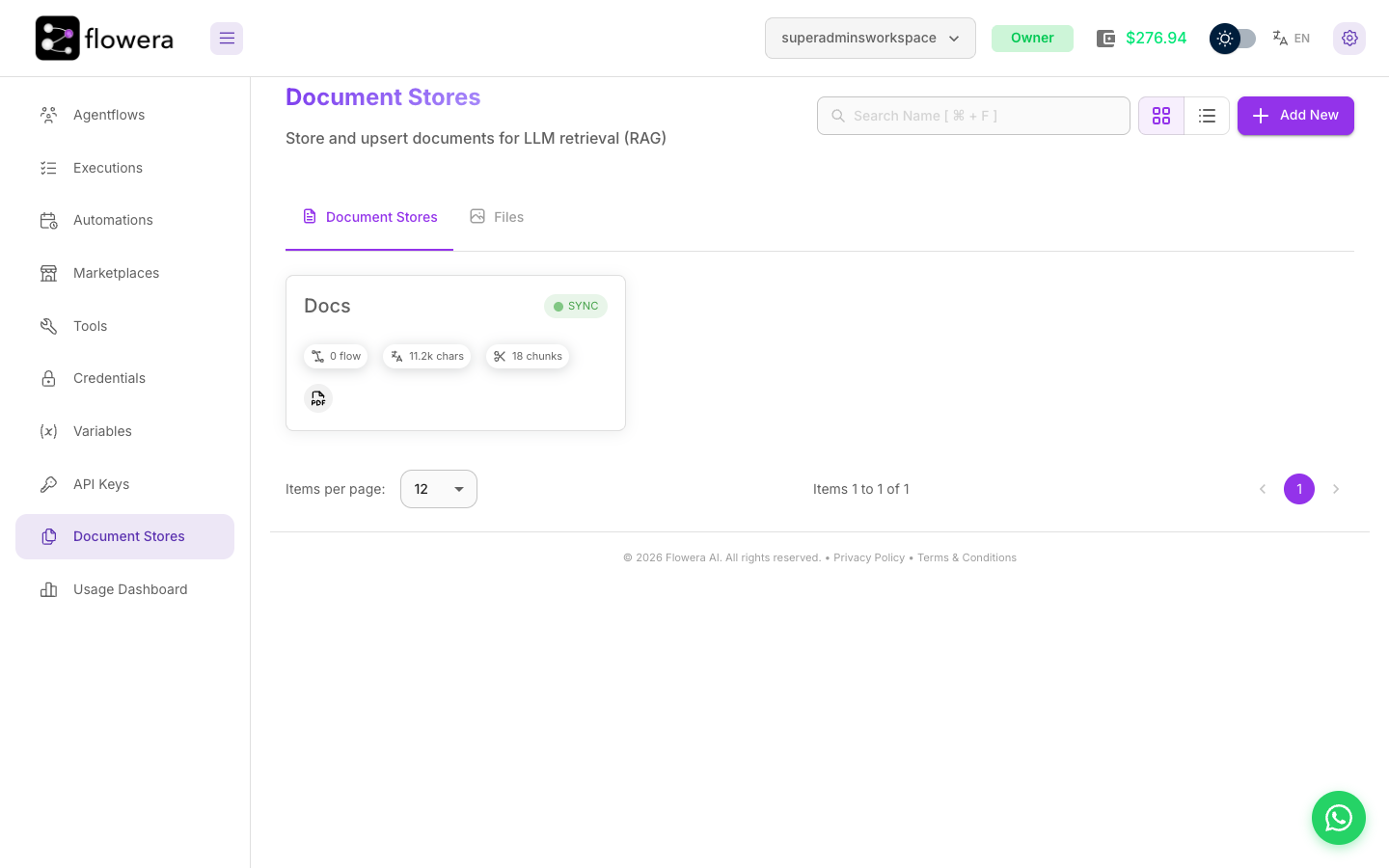
Two different things, one page
The Document Stores page in the left menu has two tabs, and they solve different problems:
| Tab | What it holds | What a flow does with it |
|---|---|---|
| Document Stores | Your documents, split into chunks and indexed for search | Searches them mid-conversation to ground its answer |
| Files | Static files — logos, price lists, PDFs you send to customers | References them by URL and hands them over |
The first is knowledge. The second is assets. A support bot typically uses both: it answers from the store, and attaches the warranty PDF from the file library.
How knowledge works
The mechanism is called RAG — retrieval-augmented generation — and it's simpler than the acronym suggests:
Your documents  →  split into chunks  →  turned into vectors  →  stored
                                                                    ↓
Customer asks a question  →  turned into a vector  →  most similar chunks found
                                                                    ↓
                                       Chunks + question  →  model  →  answer
The model never memorises your documents. It gets handed the handful of passages most relevant to this question, and answers from those. That's why it can cite your actual refund policy instead of inventing a plausible one — and why keeping the store up to date matters more than picking a clever model.
Each step has a page here:
- Document stores — create the container.
- Document loaders — get your content in, from 38 sources.
- Chunking — how documents get split, and why the size matters.
- Vector store — embeddings, indexing, and upserting.
- Query playground — check what the store actually returns before a customer does.
Then wire it into a flow with the Retriever node, which is how a flow reads from a document store.
When you need this — and when you don't
| Situation | Do you need a document store? |
|---|---|
| Answers come from a handful of facts you can write in a prompt | No. Put them in the system prompt |
| Answers live in documents that change, or are too long for a prompt | Yes |
| You need the bot to quote policy accurately | Yes |
| The data is live — stock levels, order status | No. Use an HTTP node or a tool |
A document store is for knowledge that's large and slow-moving. Anything that changes minute to minute should be fetched at run time, not indexed.
In this section
- Document stores — creating and managing stores
- Document loaders — getting content in
- Chunking — splitting documents well
- Vector store — embeddings and indexing
- Query playground — testing retrieval
- API access — managing a store from code
- Assets — the file library